Title : Spoon Sizes and other matters ...
link : Spoon Sizes and other matters ...
Spoon Sizes and other matters ...
A question? When you are baking/cooking perhaps making your favourite meal or baking a cake do you always weigh the ingredients?Perhaps you may do when it's a new recipe you are trying out but if it's a tried and trusted one you may well measure by the eye!
Growing up there was always a wonderful aroma coming from the kitchen. My dear mum spent a lot of time in the kitchen and her meals, the cakes she made were just delicious.
I can also remember visiting my Grans (my mums mum) and her kitchen too was always a special place to visit ... if she was baking she would always invite me to help out ... lovely memories.
Coming away from memories and into 2025 the internet, television, food bloggers etc have really opened our eyes to the many different cuisines and cooking traditions there are.
This is great but one drawback is that the way countries measure their ingredients, may or may not align with metric or imperial standards. For instance, traditional Asian cooking often uses “handfuls” or “pinches,” whereas Mediterranean cuisine might rely more on the “splash” or “drizzle” when adding ingredients.
In the UK, recipes often specify weights in grams, while in the US, volume measurements like cups and tablespoons are the standard. For international recipes, it’s important to recognise that ingredients might be described differently depending on the system used by the author.
I know when I share a recipe on some (but not all) I link to a conversion chart, of course many of you will have a favourite conversion chart you use ... it could even be your own notes in a recipe type journal!
Two sites I use quite regularly are these here and here
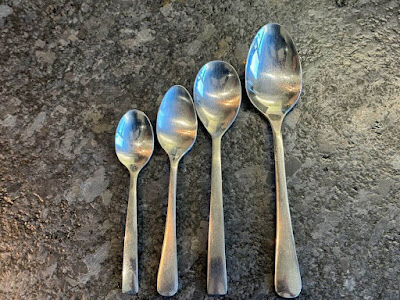
Recipes often give ingredients in “spoons” but what if you don’t have the particular spoon to hand? And is your soup spoon the same as a table spoon? Well put the ladle down, here is a handy conversion chart for the most popular sizes capacity.
Common Cooking Measurements
Teaspoons (tsp)
Tablespoons (tbsp)
Cups
Fluid Ounces (fl oz)
Summer vegetable and butter bean stew : A slow cooker recipe : see it here
Locro : Southern American Stew ... so warming : see it here
Two sites I use quite regularly are these here and here
But, now coming to the title of this post which is 'Spoon Sizes and other matters'

Here is a brief guide to spoons sizes, and for anyone, who needs to know how many teaspoons in a tablespoon in a hurry. Or what does a ’rounded’ tablespoon mean, or how much does 3 level tablespoons of flour weigh?
Recipes often give ingredients in “spoons” but what if you don’t have the particular spoon to hand? And is your soup spoon the same as a table spoon? Well put the ladle down, here is a handy conversion chart for the most popular sizes capacity.
Teaspoons (tsp)
- Metric: 5 ml
- Imperial: 5 ml
Tablespoons (tbsp)
- Metric: 15 ml
- Imperial: 15 ml
Cups
- Metric: 240 ml
- Imperial: 284 ml (UK) or 237 ml (US)
Fluid Ounces (fl oz)
- Metric: 30 ml
- Imperial: 28.4 ml (UK) or 29.57 ml (US)
Some Other Measurements Used in Cooking, but there are more than these!
Pinch
A pinch is a small amount of an ingredient, typically between 1/16 and 1/8 teaspoon. It’s a common unit of measurement for spices and seasonings like salt or pepper. It’s handy here to know the impact spices and chilli can have to taste and strength, and it’s better to go under, taste, then add more.
Pinch
A pinch is a small amount of an ingredient, typically between 1/16 and 1/8 teaspoon. It’s a common unit of measurement for spices and seasonings like salt or pepper. It’s handy here to know the impact spices and chilli can have to taste and strength, and it’s better to go under, taste, then add more.
- Comparison: Approximately 0.3 ml.
Dash
A dash is typically slightly larger than a pinch, often about 1/8 teaspoon.
A dash is typically slightly larger than a pinch, often about 1/8 teaspoon.
- Comparison: Approximately 0.5 ml.
Sprinkle
This measurement is even less precise and refers to the action of scattering or lightly covering food with an ingredient. It’s used for toppings or small garnishes, like cheese or herbs.
This measurement is even less precise and refers to the action of scattering or lightly covering food with an ingredient. It’s used for toppings or small garnishes, like cheese or herbs.
- Comparison: Approximately 1-2 ml, depending on the ingredient and how much is “sprinkled”.
There are even recipes that may call for 'A drop or Eye of the Needle' or a 'dollop'.
I do wonder who came up with these titles? That could be a post for another time!
For now, I wish you all a good new week (well it is Monday as I hit the publish button). I also give links below to three recipes you may wish try.
All the best Jan
Thus Article Spoon Sizes and other matters ...
That's an article Spoon Sizes and other matters ... This time, hopefully can give benefits to all of you. well, see you in posting other articles.
You are now reading the article Spoon Sizes and other matters ... with the link address https://avoidcancerz.blogspot.com/2025/06/spoon-sizes-and-other-matters.html
0 Response to "Spoon Sizes and other matters ..."
Post a Comment